|
OSCE question 3. |
Marks |
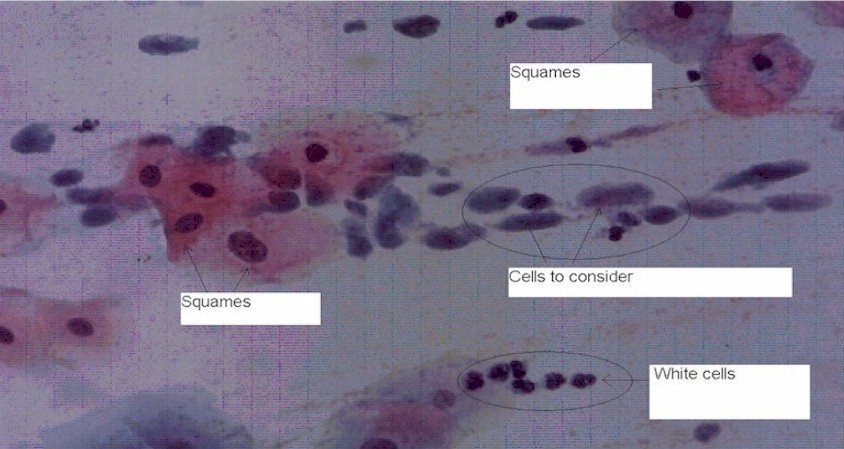
Study the picture and answer the questions below.
1. What type of specimen is the subject of this photograph?
What report would be associated with it?
| This is a photomicrograph of a cervical smear. |
2 |
2.
What organism is displayed?
| Trichomonas vaginalis. |
2 |
3.
What is its characteristic feature?
| It has a flagellum. The
shape of the bug and the flagellae tend to be distorted on smears,
presumably as a result of the fixation process. However, the bugs are
obviously large and you can just about make out the presence of flagellae.
If you look elsewhere on the slide, you can see more specimens of
trichomonas. It is noteworthy that it is large: bigger than a white cell,
so it is not a bacterium. Any picture in the examination of a flagellate
organism will be Trichomonas. |
1 |
4.
What drug would you use to treat it and in what dosage?
| Metronidazole. BNF says 200mg. t.d.s. for 7
days or 400mg. b.d. for 5-7 days. |
2 |
5.
What advice would you give about the use of this drug in the first
trimester?
| BNF advice is:
“manufacturer advises avoidance of high-dose regimes”. Similarly with
breast feeding the BNF advice is: “significant amount in milk:
manufacturer advises avoid large single doses”. |
1 |
6. What further steps would you take if the organism was causing vaginal discharge in a pre-pubertal child?
| The organism is sexually transmitted. Discuss the case with the Consultant Paediatrician who heads the Child Abuse Unit. |
2 |
You could well get a
picture of a bug or the associated infection. The various types of discharge
will be dealt with in the MCQ papers – white & “curdy”, green and
frothy, grey and smelly, etc. - what a charming list!
If it is a bug, have a look
at the specimen to see what clues there are. If it is intracellular, it is
gonorrhoea. If it has flagellae, it is Trichomonas. If it has long stringy bits
(hyphae) it is Monilia.